
Article
Appalus Intelligence Loom™: A Human-Led, AI-Accelerated Approach to Technology Delivery
Artificial intelligence is changing how technology is imagined, designed and built. However, giving development teams access to AI tools does not, by itself, create an AI-enabled delivery model.
Enterprise technology has never been only about producing code. It requires an understanding of the business problem, the organisation in which the solution will operate, the data that will support it and the people who will ultimately rely on it. When any of these elements is missing, faster development does not necessarily produce a better outcome.
This is the thinking behind Appalus Intelligence Loom™, our proprietary, human-led and AI-accelerated methodology for technology delivery.
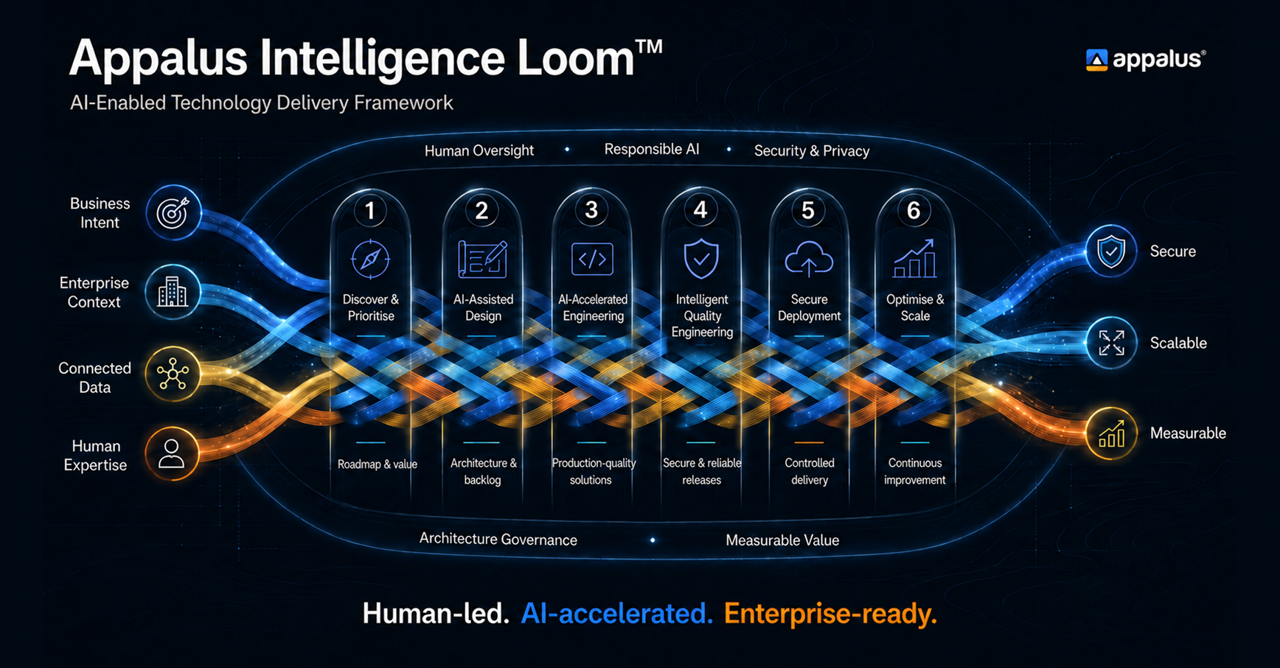
The Intelligence Loom brings together business intent, enterprise context, connected data and human expertise, carrying them through the complete delivery lifecycle, from discovery and design to engineering, assurance and continuous optimisation. Its purpose is to help organisations turn AI’s potential into technology that is secure, scalable, measurable and grounded in genuine business needs.
Why we call it the Intelligence Loom
A loom transforms individual threads into something structured, purposeful and durable. The strength of the finished fabric does not come from one thread; it comes from how the threads are selected, aligned and woven together.
Enterprise technology works in much the same way.
Artificial intelligence alone is not the solution. Data without context can be misleading. Technical expertise without a clear business objective can produce sophisticated systems that solve the wrong problem. Business ambition without engineering discipline can remain an idea rather than become a dependable solution.
The Intelligence Loom is designed to bring these elements together as one connected delivery system. AI accelerates the work, while experienced people retain responsibility for judgement, governance and outcomes.
The four threads of the Intelligence Loom
1. Business intent
Technology should begin with a clear understanding of what the organisation is trying to achieve. This includes the business problem, customer or employee need, desired outcome, operational priorities, risks and measures of success.
Business intent provides direction. It ensures that AI and engineering effort remain connected to value rather than becoming technology experimentation without a defined purpose.
2. Enterprise context
Every organisation has its own processes, systems, policies, terminology, constraints and ways of working. A solution that ignores this context may appear effective in isolation but struggle when introduced into the real enterprise environment.
The Intelligence Loom grounds delivery in this organisational reality. It considers existing architecture, integrations, security requirements, regulatory obligations, operating models and the knowledge held across the business.
3. Connected data
AI-enabled solutions depend on data that is relevant, accessible, governed and understood. The methodology examines where the required data resides, how it is connected, who owns it, how reliable it is and how it may be used responsibly.
The objective is not simply to make more data available. It is to establish the right data foundation for the intended business outcome while respecting privacy, security and governance requirements.
4. Human expertise
People remain central to the Intelligence Loom. Business leaders, domain specialists, architects, engineers, security professionals and end users each contribute knowledge that technology cannot infer reliably on its own.
AI can analyse, recommend, generate and accelerate. People provide context, challenge assumptions, make accountable decisions and determine whether the outcome is appropriate for the organisation.
Six stages from opportunity to continuous value
The four threads are carried through six connected stages.
Stage 1: Frame
We define the opportunity before determining the technology. This means clarifying the business problem, intended users, desired outcomes, relevant risks and measurable success criteria.
AI may assist with research, discovery analysis and the synthesis of information. Human stakeholders validate the problem, establish priorities and approve the direction.
Stage 2: Ground
We build the enterprise context required for sound decisions. Business processes, systems, data sources, dependencies, policies and constraints are identified and assessed.
This grounding reduces the risk of developing a technically impressive solution that does not fit the organisation in which it must operate.
Stage 3: Design
Business intent and enterprise context are translated into solution specifications, user journeys, architecture, integration designs, data requirements and AI guardrails.
AI can accelerate analysis and help generate design options. Architects, domain specialists and business stakeholders evaluate those options and make the decisions that shape the solution.
Stage 4: Weave
The solution is engineered using a combination of human expertise, AI-assisted development and reusable Appalus assets. Depending on the engagement, AI may support code generation, documentation, test creation, data mapping, configuration and technical analysis.
All generated outputs remain subject to engineering standards, peer review, traceability and human approval. The objective is not automation for its own sake, but better delivery with appropriate control.
Stage 5: Assure
Before release, the solution is assessed across quality, security, privacy, performance, accessibility, compliance and operational readiness.
AI can expand test coverage and identify patterns that require attention, but accountable professionals determine whether the solution meets the agreed standards and is ready to be deployed.
Stage 6: Evolve
Delivery does not finish at deployment. We monitor technical performance, user adoption and business outcomes against the original objectives. Feedback and operational evidence are used to improve the solution over time.
This creates a continuous learning loop in which technology, enterprise knowledge and delivery practices become stronger with each iteration.
Human-led does not mean AI-limited
The Intelligence Loom is intentionally human-led. This does not restrict the use of AI; it makes that use purposeful and accountable.
AI is applied where it can increase speed, improve analysis, reduce repetitive work, strengthen consistency or expand testing. People remain responsible where decisions require business judgement, ethical consideration, domain knowledge, risk ownership or approval.
This balance allows organisations to benefit from AI without losing transparency, control or accountability.
Measuring more than delivery speed
Faster delivery is valuable, but it is not the only measure of success. The Intelligence Loom is designed to evaluate outcomes across several dimensions, including:
- Time and effort saved across the delivery lifecycle
- Solution quality and defect levels
- Test coverage and release confidence
- Security and governance compliance
- User adoption and experience
- Operational efficiency
- Business outcomes and realised value
The relevant measures are agreed at the beginning of an engagement and reviewed throughout delivery. This helps distinguish genuine improvement from activity that is simply faster.
Building the Appalus way of delivering technology
Appalus Intelligence Loom™ is more than a name or visual model. It is the foundation for a repeatable delivery system supported by defined practices, governance controls, assessment tools, templates, reusable accelerators, measurement standards and practitioner training.
The methodology will continue to develop through practical application. Each engagement gives us an opportunity to test assumptions, measure results and strengthen the assets that support the framework. This is an important part of its design: the Intelligence Loom is structured, but it is not static.
From AI experimentation to trusted enterprise delivery
The question facing organisations is no longer whether AI can contribute to technology delivery. The more important question is how to apply it in a way that understands the business, respects the enterprise environment and produces outcomes people can trust.
Appalus Intelligence Loom™ provides our answer: begin with business intent, ground every decision in enterprise context, connect the right data, keep experienced people accountable and apply AI throughout the lifecycle where it creates meaningful value.
That is how separate threads become a coherent solution, and how AI-assisted delivery becomes trusted enterprise technology.
Ready to explore AI-enabled technology delivery?
Speak with Appalus about applying the Intelligence Loom to your next transformation, modernisation or application-development initiative.
Leave a Reply